What is international digital marketing?
International digital marketing is promoting a business to customers in several countries through online channels such as search, social media, email and paid ads. The channels are the same ones you use at home. What changes is the language, the offer, the rules and the competition in each market.
That’s why a strategy matters more here than in local marketing. A campaign that works in Sydney can fail in Dubai because of language, payment preferences or simply because different competitors already own the search results.
The 7-step international digital marketing strategy
Step 1: Choose markets from data, not instinct
Start with the countries that already show interest in you. Three free places to look:
- Google Search Console: Performance → + Add filter → Country. See which countries already find you in search.
- Google Analytics 4: Reports → User attributes → Demographic details, set to Country. See which countries visit and convert.
- Your inbox and CRM: where did your last 20 enquiries come from?
Then check demand with Google Keyword Planner set to each country, and Google Trends to compare interest between countries.
Pick one or two markets to start. Every extra market adds content, ads, reporting and time-zone work. I’d rather see a client win one country properly than spread thin across five.
Step 2: Research how each market searches and buys
The same service is described differently in each country. UK and Australian buyers write “optimisation”, US buyers write “optimization”. British buyers look for a “solicitor”, Americans for an “attorney”. In the UAE you may need English and Arabic.
Do keyword research separately for each country, not as one translated list. My international keyword research guide walks through this step by step, including a template.
Step 3: Localize the website before you spend on ads
Ads send people to your site, so fix the site first. For each market, check:
- Language and spelling match the country.
- Prices in local currency (USD, GBP, AUD, CAD, AED), or a clear note on how you quote.
- Local proof: case studies, reviews or client logos from that country.
- Contact options people there expect, such as a local phone format or WhatsApp.
- Country pages with hreflang if you serve several countries in the same language, so Google shows the right version.
Not sure what hreflang is? It’s explained in my SEO glossary.
Step 4: Pick channels country by country
Don’t copy your home channel mix. Check what people in each market actually use before you budget. DataReportal’s country reports and your own GA4 data are good starting points.
A practical order for most service businesses:
- Search (SEO and Google Ads) for people already looking for what you sell.
- LinkedIn if you sell to businesses.
- Meta (Facebook and Instagram) for awareness and retargeting.
- Email for people who have already shown interest, following the rules in Step 6.
Step 5: Plan for AI search in every market
Buyers now ask Google’s AI Overviews and AI Mode, ChatGPT and Copilot for recommendations. Google says the same SEO basics apply to its AI features, so a well-built country page still matters most.
What helps:
- A direct answer at the top of each key page.
- Tables and numbered steps with real numbers.
- Clear country pages, so AI tools can tell which page serves which market.
My guide on how to get cited in ChatGPT and AI Overviews covers this in nine steps.
Step 6: Follow each country’s marketing rules
Email and data rules differ more than most businesses expect. The biggest difference: the US mainly requires an easy way to opt out, while Canada, the UK and Australia generally require consent before you send marketing email.
The table below is a plain-English overview to help you plan, not legal advice. Check the official guidance (linked) or a local lawyer before you launch.
Step 7: Measure each market separately
One global number hides what’s working. Set up reporting by country from day one:
- In GA4, compare leads or sales by country, not just traffic.
- Add UTM tags to every campaign link, with the country in the campaign name (for example, ae_linkedin_oct).
- In Search Console, filter Performance by country each month.
- Track cost per lead by market, because a lead in Dubai and a lead in Toronto rarely cost the same.
Market comparison: US, UK, Australia, Canada and UAE
| United States | United Kingdom | Australia | Canada | UAE | |
| Language | English (en-US) | English (en-GB) | English (en-AU) | English (en-CA); French in Quebec | English and Arabic |
| Spelling | optimize, color | optimise, colour | optimise, colour | colour, but usually -ize | Depends on audience; check both languages |
| Currency | USD | GBP | AUD | CAD | AED |
| Time difference from Nepal | 9h 45m to 10h 45m behind (New York) | 4h 45m to 5h 45m behind | 4h 15m to 5h 15m ahead (Sydney) | 9h 45m to 10h 45m behind (Toronto) | 1h 45m behind |
| Email marketing rules | CAN-SPAM: clear opt-out, honest subject lines | UK GDPR and PECR: consent usually needed | Spam Act 2003: consent needed, working unsubscribe | CASL: consent needed | Federal Decree-Law No. 45 of 2021 (PDPL) on personal data |
| Watch out for | Large, competitive market: start with a niche or a few states | Local proof and reviews matter | Very different seasons and business hours | Quebec: French language rules for commercial content (Bill 96) | Arabic content and local trust signals |
Time differences change with daylight saving in the US, UK, Canada and Australia.
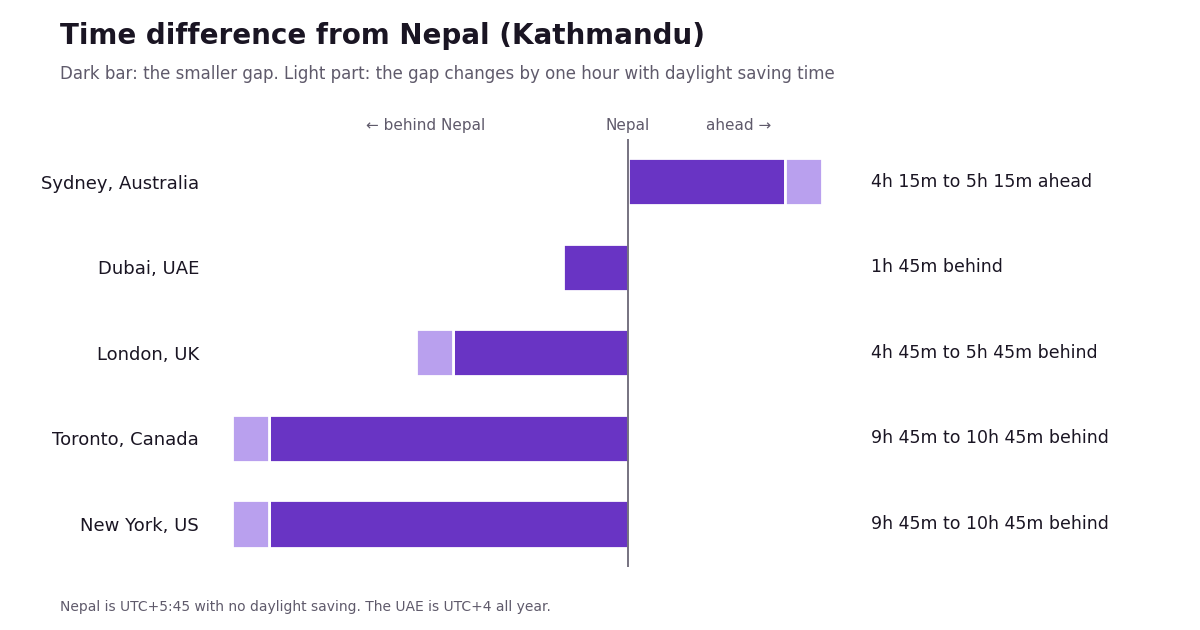
Time difference from Nepal
What this looks like in practice
As the SEO strategist for NAPS, a higher-education provider in Australia, I worked on one market from Nepal with a clear focus: search visibility in Australia. In six months, Google organic clicks grew from 85.3K to 137K (+60.6%). The site also earned 105K impressions in Google’s AI features, and Bing AI citations grew from 3.9K to 6.3K.
The point for this guide: those results came from focusing on one market, not from a global campaign. The full NAPS case study shows what changed.
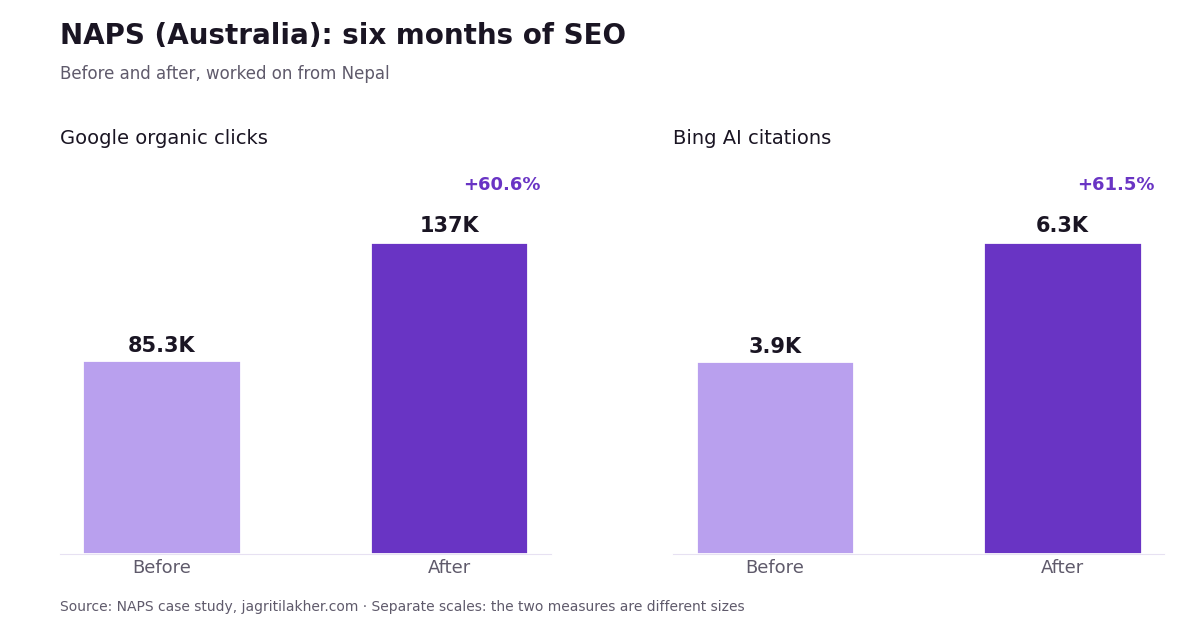
NAPS results
A 90-day international digital marketing plan
| Weeks | Focus | Output |
| 1–2 | Market choice | 1–2 target countries chosen from Search Console, GA4 and enquiry data |
| 3–4 | Research | Keyword list per country, top 5 competitors per country, channel check |
| 5–8 | Website | Localized pages, currency and proof per market, hreflang if needed, tracking and UTMs set up |
| 9–10 | Launch | Search ads and LinkedIn or Meta campaigns in each market’s time zone |
| 11–12 | Review | Leads and cost per lead by country; keep what works, cut what doesn’t |
After 90 days you’ll know which market deserves more budget, based on leads rather than guesses.
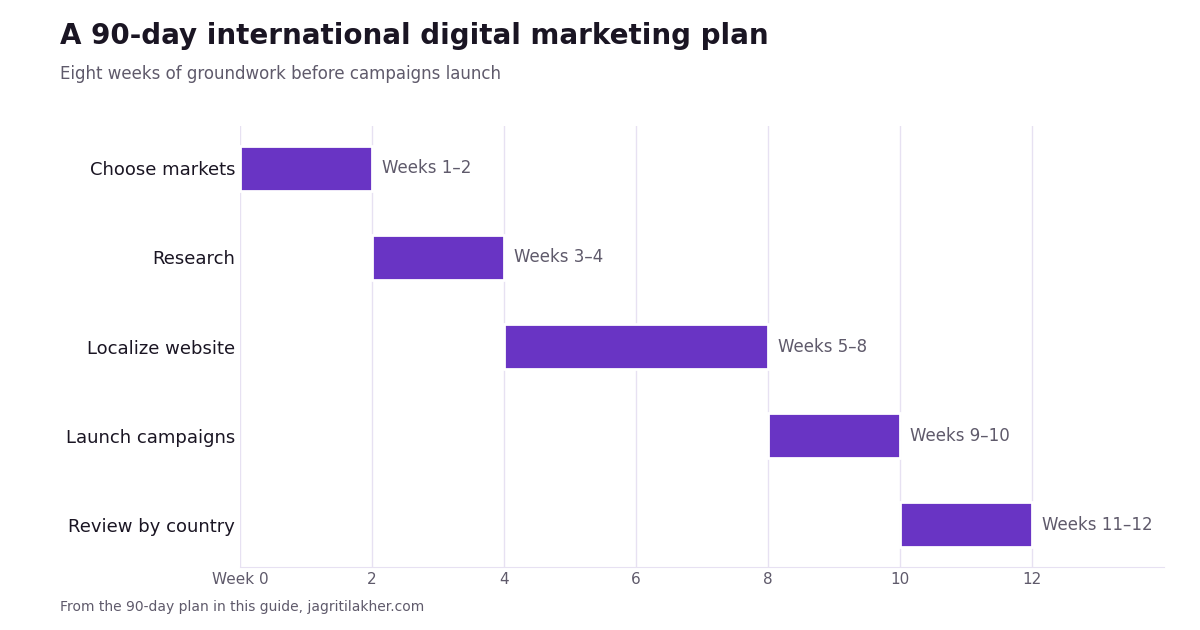
90-day plan
Common international digital marketing mistakes
- Translating instead of localizing. Word-for-word copy misses local terms, offers and proof.
- Launching in five countries at once. Budgets and attention get spread too thin to learn anything.
- Ignoring consent rules. A list that’s fine to email in the US may not be in Canada, the UK or Australia.
- Sending ads to a home-market page. Wrong currency, wrong spelling and no local proof waste the click.
- Reporting one global number. Without country-level data you can’t tell which market is paying off.
Frequently asked questions
Q1. What is an international digital marketing strategy?
It’s a plan for attracting customers in more than one country through online channels. It covers which markets to enter, how to adapt your website and messages for each, which channels to use there, and how to measure results by country.
Q2. What are the 5 stages of international marketing?
A common textbook model has five stages: domestic marketing, export marketing, international marketing, multinational marketing and global marketing. Each stage means a business adapts more of its marketing to individual countries, and most small businesses start at the export stage.
Q3. How is international digital marketing different from local digital marketing?
The channels are the same, but you plan for several languages, currencies, sets of rules and groups of competitors at once. You also measure each market separately, because results often differ a lot between countries.
Q4. Which country should I target first?
Start with the country that already shows the most interest: where your search impressions, website visits and enquiries come from. Then check demand and competition there before committing a budget.
Q5. Do I need a separate website for each country?
Usually not. Most businesses can use one website with a section for each country, such as /au/ or /uk/, plus hreflang tags. Separate country domains make sense when you need a very strong local presence and can maintain several sites.