Table of Contents
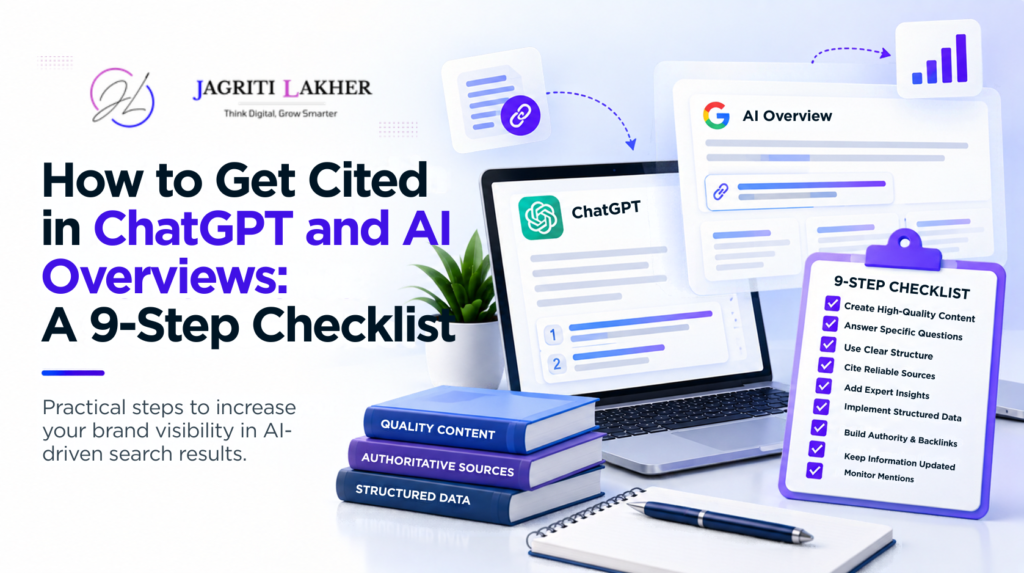
To get cited in ChatGPT and Google AI Overviews, let their crawlers reach your pages, rank well in ordinary search, put a direct answer under each question heading, and back it with data and mentions only you can offer.
Google says optimizing for its AI features is still SEO, and neither Google nor OpenAI asks for special markup or an llms.txt file.
Advice on AI citations is full of conflicting numbers. This guide sorts it into three piles: what Google and OpenAI confirm, what studies only show as a correlation, and what Google calls unnecessary. Then it gives you nine steps and a way to measure the result.
Want to tick these off as you go? Use the free AI search optimization checklist: 30 checks you can download as a PDF.
What is confirmed, what is correlation, and what is a myth
| Pile | What it includes | Where it comes from |
|---|---|---|
| Confirmed | A page must be indexed and eligible for a snippet to appear in Google’s AI features. ChatGPT search only surfaces pages that OAI-SearchBot can reach. Original, helpful content matters most. | Google’s guide and OpenAI’s crawler documentation |
| Correlation | Short direct answers under headings, original data, mentions on other sites, fresh updates. | Studies by SEO firms and publishers, which show what cited pages have in common, not what causes citations |
| Myth (per Google) | llms.txt files, splitting pages into tiny chunks, rewriting content for AI, special schema or Markdown versions, manufactured mentions. | Google’s own list of things you do not need to do |
Google’s guide describes AI search optimization as the same work as improving the search experience, so it is still SEO. That is the main reason the checklist below leans on basics.
The 9-step checklist
1. Let the right crawlers in
ChatGPT search relies on a crawler called OAI-SearchBot. OpenAI says sites that opt out of it will not be shown in ChatGPT search answers, though they can still appear as plain links.
GPTBot is a separate crawler used for training, and ChatGPT-User handles requests triggered by a person, so you can allow one and block another. OpenAI notes that robots.txt changes can take about a day to take effect.
A simple setup that allows search citations and blocks training looks like this:
# Let ChatGPT search cite your pages
User-agent: OAI-SearchBot
Allow: /

# Optional: keep your content out of model training
User-agent: GPTBot
Disallow: /
Whether to block GPTBot is your choice. It has no effect on ChatGPT search. Also check that a CDN or firewall rule is not blocking bots that robots.txt allows, and that your key pages are not set to noindex or nosnippet, because Google says a page must be indexed and eligible for a snippet to appear in its AI features. My technical SEO checklist covers the crawl and indexing checks.
2. Rank in normal search first
Google says its AI features are rooted in its core ranking and quality systems, so the work that earns rankings also feeds AI visibility. Do not treat AI citations as a separate channel with separate rules.
Add Bing to your routine as well. Several analyses say ChatGPT’s live search draws on Bing’s index. OpenAI does not document that, but verifying your site in Bing Webmaster Tools and submitting your sitemap costs little and gives you Bing’s AI reporting (step 9).
3. Put a direct answer under every question heading
The Search Engine Land audit of nearly two million sessions found that pages cited by ChatGPT most often had what it calls an answer capsule: a short, self-contained answer of about 20 to 25 words placed right after a question-style heading. It also found that keeping links out of that capsule correlated with more referrals. Treat both as patterns, not rules.
Here is the difference in practice.
Before: heading “Should I block GPTBot?”, followed by three paragraphs about the history of web crawlers.
After: heading “Should I block GPTBot?”, followed by: “Blocking GPTBot stops training use only. ChatGPT search citations are controlled separately by OAI-SearchBot, so you can block one and allow the other.”
This is not the chunking Google says you can skip. You are not splitting the page into tiny pieces. You are answering the question first, which also helps a human skimming the page.
4. Add something only you have
Google says unique content that people find helpful will affect your presence in AI search more than any other tip in its guide. The Search Engine Land audit found original data was the second most common trait among cited pages. Generic advice can be found anywhere, so the AI has no reason to pick yours.
Original material can be a case study with before and after numbers, a screenshot from your own Search Console, a benchmark from your client work, or a named method you actually use. For example, for NAPS, an Australian higher-education provider, Search Console showed about 105K impressions in Google’s AI features over six months, up from none in the previous six. Its Bing AI citations rose from 3.9K to 6.3K over the same period.
5. Use tables and lists for facts people compare
Costs, steps, options and timelines are easier to lift from a table or numbered list than from a paragraph. Google does not require this, and I have not seen firm proof that it changes citations. I use tables because they also help readers compare, which is reason enough.
6. Show who wrote it and when
Put an author name, a published date and an “updated” date on the page, and cite the sources you rely on. I treat this as good practice, not a confirmed AI ranking factor. It makes your page easier to trust and to check, for people and machines alike.
7. Earn mentions on other sites
Several studies find that brands mentioned across the web are more visible in AI answers than brands that only publish on their own site. That is a correlation, so do not expect a guaranteed result from it. It does match how the web works: other people describing you is a stronger signal than you describing yourself.
Practical ways to earn genuine mentions include answering questions on LinkedIn or Reddit where you can back the answer with experience, appearing on podcasts, writing for industry sites, and keeping profiles on relevant directories accurate. Google lists manufactured mentions among the things you do not need, so skip anything that looks fake.
8. Refresh the pages that matter
Update key pages when the facts change: new numbers, new tool screens, new Google or OpenAI guidance. Change the “updated” date only when you have made a real change. Freshness shows up in several studies as a correlation, and stale advice in a fast-moving topic hurts readers anyway.
9. Measure it
You can measure AI visibility in four places:
| Where | What it shows | Notes |
|---|---|---|
| Google Search Console, Generative AI report | Impressions in AI Overviews and AI Mode | Launched 3 June 2026 and rolling out gradually, so you may not see it yet. It shows impressions, not clicks.” with: Available to all Search Console users since 31 August 2026. It shows impressions, not clicks. (Search Engine Land reported the global rollout on 31 Aug 2026.) |
| Bing Webmaster Tools, AI Performance | Citations, cited pages, grounding queries | Public preview since February 2026. Data exports as CSV. |
| Google Analytics | Visits from ChatGPT | OpenAI says referral links include utm_source=chatgpt.com |
| A monthly prompt check | Whether you are named or linked | You run it by hand and record the results |
For the prompt check, pick 10 questions your buyers ask and run them monthly in ChatGPT, Google (with AI Overviews or AI Mode where available) and Copilot. Record three things for each: whether your site is cited, which page, and which competitor is cited instead. The competitor column tells you what to write next.
What to skip
Google’s guide names these as unnecessary for its AI features:
- llms.txt files. Google treats them like any other text file. Other crawlers may use them, but you should not expect a boost in Google.
- Splitting pages into small chunks. Google says its systems can find the relevant passage on a normal page.
- Rewriting content just for AI. Google says its systems understand synonyms and general meaning.
- Special schema or Markdown versions of pages. There is no special markup for AI features. FAQ rich results also stopped appearing in Google Search on 7 May 2026, so FAQ schema will not change how your listing looks.
- Manufactured mentions. Real mentions help. Fake ones do not.
If you sell in more than one country
Google’s AI features do not roll out in every market at the same time, so a page can be eligible in one country and not in another. Track your results by country, and use hreflang to send each searcher to the right version, as covered in my international SEO strategy guide. If you are also weighing who should run this for you, read how to hire an international SEO consultant before you sign anything. And for the bigger picture on how search is changing, see how AI is changing SEO.
What to expect
Citations are not clicks. The Google report showed impressions only at launch, and Bing’s report counts citations, so a page can be cited often and still send little traffic. Judge results by what matters to your business: visits from AI sources, enquiries and leads.
Nobody can promise a citation. AI answers change, and neither Google nor OpenAI publishes a formula. What you can control is whether your pages are reachable, useful, and easy to quote. If you want help with this, see my SEO and AI search optimization service.
FAQ
Q1: Do I need an llms.txt file to be cited?
Not for Google. Google says it treats llms.txt like any other text file. Other crawlers may read it, but I would not spend time on it before the basics above.
Q2: Do I need special schema markup?
No. Google says there is no special markup for its AI features. Normal Article markup is fine, and it helps in other ways.
Q3: Do I have to rank first on Google to be cited?
No, but ranking well helps, because Google’s AI features are built on its core ranking systems.
Q4: Can a small site get cited?
Yes, if your pages are reachable, answer questions directly, and offer something original. A small site with real data and clear answers can beat a large site with generic ones.
Q5: How do I know whether I am being cited?
Use the Generative AI report in Search Console, the AI Performance report in Bing Webmaster Tools, Google Analytics referrals from chatgpt.com, and a monthly prompt check.
What to expect?
Run the free AI search checklist on your most important page first.
Ready to Grow in New Markets?
Tell me where you want to grow, and I’ll show you what it would take to get there.
Or email: info@jagritilakher.com

Jagriti Lakher
Jagriti Lakher is an international SEO and digital marketing consultant with 7+ years of experience working with businesses across different industries and countries. She specialises in SEO, digital marketing, analytics, website development, and AI automation, and is the founder of The Purple Bytes. She writes about SEO, technology, digital marketing, AI, and the evolving digital landscape.
Share this Post :
Related Posts
WORK WITH ME
Grow Online. Get More Clients.
One consultant for your marketing, website, automation and data, so every part works together.
No complicated sales pitch. No pressure. Just conversation about your business.
CLIENTS RESULTS
Results From My Case Studies
Organic Clicks
+
0
%
Google AI Features Impressions
0
K
Social Media Impressions
+
0
%
LinkedIn Engagement
+
0
%
RELATED POSTS
Get the Growth Insights

October 1, 2026
How to Get Cited in ChatGPT and AI Overviews: 9-Step
September 29, 2026
How to Hire an International SEO Consultant (2026 Guide)
September 29, 2026