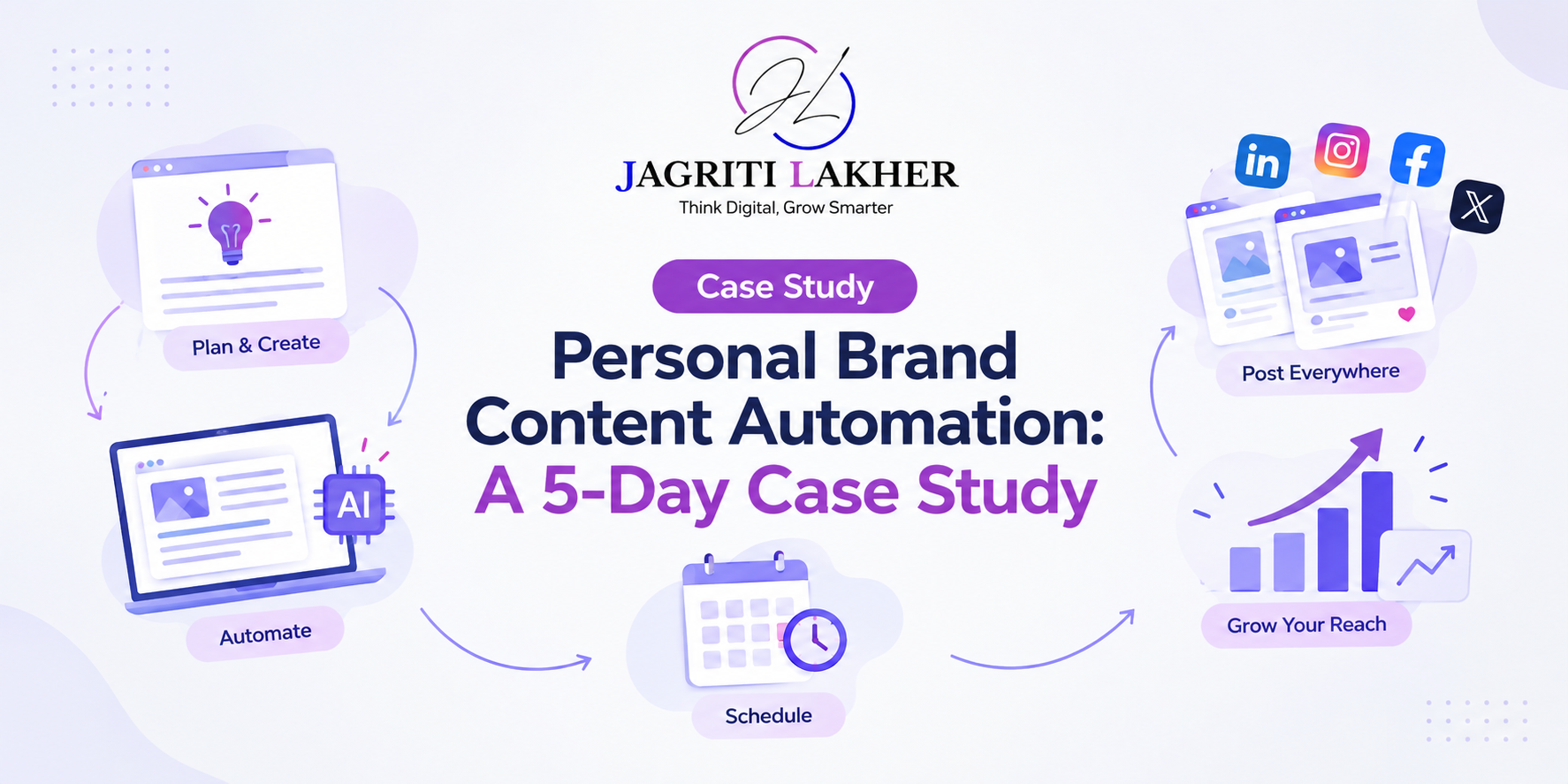
Personal Brand Content Automation: A 5-Day Case Study
Table of Contents
Posting every day on three platforms is a lot of work: find a topic worth talking about, check the facts, design the slides, write a caption for each platform, then upload it three times. Most weeks that is the first job to slip – which is exactly why I built this personal brand content automation system in the first place.
So I built a pipeline that does the whole thing on a schedule. Twice a day it picks a current digital-marketing story, confirms it against at least two named sources, turns it into a 7-slide branded carousel, writes a caption for each platform, and publishes it: a document post on LinkedIn, a native carousel on Instagram, and a photo post on Facebook.
The two daily slots cover different grounds so they never repeat each other. Mornings are for SEO and AI search optimization, technical SEO and new industry data. Evenings are for social media platform changes, AI in marketing, performance marketing, and content strategy.
How it works
- Research: Picks a current story and checks it against 2+ named sources with dates and figures.
- Design: Builds a 7-slide carousel in my locked brand design system.
- Write: Writes three captions, each shaped for its platform, using a structured social media marketing strategy.
- Check: Check every slide for hidden or clipped text before anything goes out.
- Publish: Posts to LinkedIn, Instagram and Facebook, then sends me one summary.
Challenges
Automating LinkedIn, Instagram and Facebook posting for my own brand rarely went smoothly on the first try. Here is exactly what broke while I built this personal brand content automation system, and what I changed.
LinkedIn silently rejected the carousels
Problem: The PDF uploaded fine, then failed in LinkedIn’s own processing with a generic “try again” error, three times in a row.
Fix: I traced it to how the PDF was exported. Every file is now re-encoded before upload, and LinkedIn has accepted every carousel since.
My computer isn’t always on
Problem: Publishing needs a logged-in browser, but my laptop can be closed at 10 AM.
Fix: Research, design and writing run in the cloud through AI workflow automation, so a finished post is always produced. The run waits up to 15 minutes for my browser after the notification arrives; if it still can’t reach me, it sends the ready-to-post files instead of skipping the day.
Two posts a day can repeat, or double up
Problem: On day three a manual post and a scheduled post went out for the same slot within minutes of each other.
Fix: I split the topics by slot (SEO mornings, social/AI/ads evenings) and added a check that looks for an existing post on each platform before publishing.
Keeping the brand consistent
Problem: Early runs drifted: plainer layouts, a placeholder logo, and once a label hidden behind a decorative circle that went out live.
Fix: I locked one design system, pointed every run at a single master logo file, and added an automatic overlap check plus a slide-by-slide visual check before posting.
Every platform behaves differently
Problem: Instagram discards a draft if you press Escape, Facebook has two upload boxes on the same screen, and long captions could get cut off.
Fix: I wrote a separate posting routine for each platform. Captions are entered in parts and read back in full before the post button is pressed.
The call to action didn’t match its link
Problem: Slides said “15-min consultation” while the booking link pointed to a 30-minute event.
Fix: I moved to a dedicated 15-minute booking page, so the wording and the link now match on every slide and caption.
Results
These are the numbers behind this personal brand content automation case study so far:
- 2 posts a day, 3 platforms, one system. Every slot produces a researched carousel plus three platform-specific captions, with me designing or writing none of them.
- 10 carousels in the first 5 days. 70 branded slides and 30 platform-specific captions, covering Google updates, AI search visibility, Instagram and LinkedIn changes, and Google Ads.
- Same-day news coverage. Google’s September 2026 spam update (logged on the Google Search Status Dashboard) began rolling out late on 24 Sep (Nepal time). A carousel explaining it was ready for 10 AM the next morning.
- No empty days. When the browser can’t be reached, the finished post still arrives, ready to upload, instead of the slot being lost.
- Quality rules, not good intentions. Brand design, logo, link and text visibility are now enforced by checks that run on every post.
It’s still early. Over the first 30 days I’ll be tracking reach, engagement and consultation bookings, and I’ll add those numbers here.
Key Highlights
- Research first: Every post is built on named sources, dates and figures, not general commentary.
- Native on each platform: A document post on LinkedIn, a native carousel on Instagram, a photo post on Facebook, each with its own caption.
- A locked brand system: Bordered content cards, numbered sections, stat panels and one master logo on every slide.
- I stay in charge of judgement: I can override the topic any time. The spam-update post was one such call, made the night before.
- Safety rails built in: Duplicate-post check, 15-minute browser wait, text-visibility check, and paid boosting always left off.
- Built and refined in 5 days: Each problem found in a live run became a permanent rule for every run after it.
Timeline So Far
| 21 Sep Pipeline goes live on LinkedIn. First carousels published; the silent PDF rejection is found and fixed. |
| 23 Sep Second daily slot added with split topics. Instagram and Facebook join; the first three-platform post goes live and earlier carousels are back-filled. |
| 24 Sep Brand design system locked. 15-minute browser wait and duplicate-post check added. A “I post to 3 platforms every day” carousel goes live everywhere. |
| 25 Sep Text-visibility checks added after a hidden label slipped through. Booking link moved to a matching 15-minute page, master logo source fixed, and the Google spam update carousel produced for the morning slot. |
Want a content system like this for your brand?
If this personal brand content automation case study sounds like where you’re stuck, book a free 15-minute call and I’ll walk through what it would look like for you.
Book: cal.com/jagriti/15min Email: info@jagritilakher.com
Frequently Asked Questions
What is personal brand content automation?
Personal brand content automation is a system that handles the repeat work behind someone’s own posts – finding a topic, checking facts, designing visuals, writing captions and publishing – on a schedule, so a founder doesn’t have to do it by hand every day.
Which platforms does your automation publish to?
Mine publishes natively to LinkedIn (as a document post), Instagram (as a carousel) and Facebook (as a photo post), with a caption written specifically for each platform.
How do you make sure the content is accurate?
Every topic is checked against at least two named sources with dates and figures before it becomes a carousel, so posts are built on reporting rather than general commentary.
What happens if your computer or browser isn’t available at posting time?
Research, design and writing happen in the cloud regardless, so a finished post is always ready. The system waits up to 15 minutes for a browser connection; if none is available, it sends me the ready-to-post files instead of skipping the slot.
Does an automated system like this stay on-brand?
Yes – mine runs on a single locked brand design system and a master logo file, with an automatic check for overlapping or hidden text before anything posts. The exact fixes that got it there are covered in the challenges section above.
Can you build this for my business?
Yes. That’s exactly what this personal brand content automation case study is meant to show is possible. Book a free 15-minute call and I’ll map out what a research-to-publish pipeline would look like for your brand and cadence.

About the Author
Jagriti Lakher is an International Digital Marketing Consultant specializing in SEO, website development, digital marketing, performance marketing, and AI-driven search strategies. She works with businesses looking to improve their online visibility, attract qualified leads, and grow sustainably through data-driven digital marketing. Her approach combines technical expertise, strategic thinking, and practical implementation to help organizations build long-term organic growth across international markets.
Found This Useful ?
Share This With Your Network
Social Media Case Study: How Map My Books Grew Impressions by 77% in the UAE